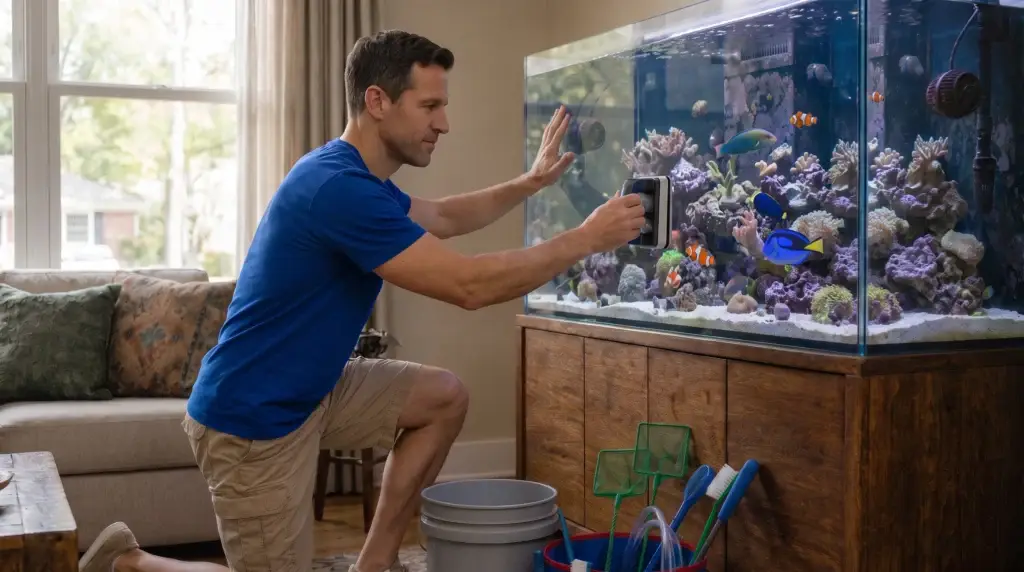
Aquarium maintenance is the ongoing routine of testing water, changing water, cleaning equipment, and checking on livestock that keeps a fish tank’s closed biological system stable over time. Unlike installation — which is a one-time setup — maintenance never really stops: a tank that gets neglected for even a few weeks can drift into cloudy water, algae blooms, or a fish kill, even if it was set up perfectly.
Whether you’re keeping a 20-gallon community tank in Smyrna or a 180-gallon reef display in a Nashville office lobby, the difference between a tank that thrives for a decade and one that’s a constant source of stress almost always comes down to maintenance consistency. Here’s exactly what that routine looks like, what it costs, and when it makes sense to hand it off to a professional.
An aquarium is a closed ecosystem that fish waste, uneaten food, and evaporation are constantly pushing out of balance. Without regular intervention, ammonia and nitrite — both toxic byproducts of the nitrogen cycle — can build up faster than beneficial bacteria can process them (PetMD).
Skipping maintenance doesn’t just make a tank look dirty. It compounds into real problems:
Nitrate and phosphate buildup that fuels algae blooms and stresses fish long before parameters get dangerous.
Reduced filter performance as media clogs with debris, which cuts oxygen exchange and biological filtration capacity.
Equipment failures that go unnoticed — a failing heater, a jammed pump, or a clogged protein skimmer are far more likely to cause a crash in a tank that isn’t being checked regularly.
Faster, harder-to-reverse water quality swings in saltwater and reef systems specifically, where calcium, alkalinity, and salinity all need to stay within a narrow range (Wright Aquarium Services).
The good news: almost all of this is preventable with a consistent schedule. It’s the consistency that matters more than any single deep clean.
Every credible maintenance guide breaks the routine into the same basic rhythm — small daily checks, a core weekly service, and a deeper monthly pass (Healthy Aquariums):
| Frequency | Time needed | Key tasks |
|---|---|---|
| Daily | 5–10 minutes | Observe fish behavior and appetite, confirm filter/heater/lights are running, check temperature, remove uneaten food, top off evaporation |
| Weekly | 30–60 minutes | Test ammonia, nitrite, nitrate, and pH (or full reef parameters); partial water change of 10–30%; scrape algae off the glass; rinse mechanical filter media in old tank water (never tap water) |
| Monthly | 1–2 hours | Deep-clean the glass canopy and light fixture; inspect and service the heater, pumps, and skimmer; replace chemical filter media (carbon, etc.); vacuum substrate more thoroughly; log parameter trends |
| Quarterly | 1–3 hours | Inspect all plumbing and connections for leaks or wear; deep-clean sumps and overflow boxes; evaluate whether stocking or bioload changes call for an adjusted schedule |
A few rules show up consistently across every source worth trusting:
Never replace all filter media at once. Doing so wipes out the beneficial bacteria colony and can restart the nitrogen cycle, exposing fish to ammonia spikes (ChecklistGuro).
Rinse mechanical media in tank water, not tap water. Chlorine and chloramine in tap water kill the beneficial bacteria you’re trying to preserve.
Water changes should never be skipped in favor of “just testing.” Testing tells you there’s a problem; only water changes and filtration actually fix it.
The schedule above is a baseline — actual frequency depends heavily on tank type and bioload:
| Tank type | Typical service frequency | Why |
|---|---|---|
| Freshwater community (20–75 gal) | Monthly or bi-weekly | Stable cycle, moderate bioload |
| Freshwater planted | Bi-weekly | Plants absorb nitrate, but still need parameter checks and trimming |
| Saltwater FOWLR | Bi-weekly to weekly | Salinity and alkalinity swing faster than in freshwater |
| Reef / SPS systems | Weekly | Corals need tightly controlled calcium, alkalinity, and lighting; small swings have big consequences |
| Heavily stocked or large-bioload tanks (goldfish, large cichlids, plecos) | More frequent than standard | Waste output outpaces a standard schedule |
DIY maintenance isn’t free — it just moves the cost from labor to supplies, time, and risk. Ongoing DIY costs (water conditioner, test kits, replacement media, electricity) typically run $100–$300 per month depending on tank size, with occasional professional help adding $50–$150 per visit when it’s needed (The Aquarium Expert).
For a fully professional maintenance plan, national cost data breaks down roughly like this (latestcost.com):
| Plan type | Typical cost | What it covers |
|---|---|---|
| Single service visit | $45 – $180 | Basic inspection and cleaning, per visit |
| Monthly maintenance plan | $60 – $350/month | Routine service every 2–4 weeks, testing included |
| Emergency/outside-schedule visit | $60 – $250 | Urgent issues outside the regular route |
Saltwater and reef systems typically run 40–60% higher than freshwater equivalents at every tier, mainly because of calcium/alkalinity dosing, coral health checks, and specialized filtration (Wright Aquarium Services).
Because pricing depends so heavily on tank size, water type, stocking, and how neglected a tank currently is, we don’t publish a flat maintenance rate — every service agreement is priced after a free, no-obligation consultation where we see the actual condition of the system.
A standard professional visit generally covers (Wright Aquarium Services):
Water chemistry testing — ammonia, nitrite, nitrate, pH, and for saltwater/reef systems, salinity, calcium, alkalinity, and magnesium
Partial water change sized to the tank’s bioload and stocking
Glass and viewing panel cleaning, inside and out
Filter and equipment inspection — heaters, pumps, powerheads, skimmers, and air stones checked for wear or failure
Livestock observation — noting behavior, appetite, and any signs of stress or disease
Documentation of parameters and work completed at each visit, so you have a record over time
This is the routine our own aquarium maintenance plans are built around, whether it’s a freshwater display in a Smyrna living room or a commercial reef system in a Nashville medical office. If your tank was recently set up, maintenance is also what protects the investment made during installation — the two go hand in hand.
Cloudy or discolored water that doesn’t clear up after a normal water change
Persistent or spreading algae despite regular glass cleaning
Fish that are less active, hiding more, or eating less than usual
A strong odor coming from the tank (aquarium water should smell faintly earthy, never foul)
Rising nitrate or phosphate readings between services
Equipment that’s noisier, running hotter, or showing reduced flow
Any of these usually means the current schedule needs to tighten up — either more frequent visits or a deeper service to catch up on missed work.
Reef Route Aquatics provides recurring residential and commercial aquarium maintenance throughout Middle Tennessee, including Nashville, Murfreesboro, Franklin, Brentwood, Smyrna, Mt. Juliet, Lebanon, Gallatin, Nolensville, and Spring Hill. We build custom service agreements around your tank’s actual condition and bioload rather than a one-size-fits-all schedule, and we handle everything from a single freshwater community tank to multi-tank commercial installations in offices, restaurants, and medical facilities. Take a look at what our customers say about staying on a maintenance plan with us.
How often should I do aquarium maintenance?
Daily checks take just a few minutes and catch problems early. The core service — water testing, a partial water change, and glass cleaning — should happen weekly for most tanks, with a deeper monthly pass for filter media and equipment. Reef and heavily stocked tanks often need weekly service instead of monthly (Healthy Aquariums).
How much does professional aquarium maintenance cost?
Nationally, single visits typically run $45–$180 and monthly plans run $60–$350, with saltwater and reef systems priced 40–60% above comparable freshwater tanks (latestcost.com). Because tank size, condition, and bioload all move the price, we quote every plan after a free consultation.
Can I do aquarium maintenance myself, or do I need a professional?
Many hobbyists successfully maintain smaller freshwater tanks themselves. Where a professional adds the most value is with larger systems, saltwater/reef tanks that need precise dosing, commercial installations, or when you simply don’t have time to keep a strict weekly schedule — missed maintenance is the most common cause of tank problems we’re called in to fix.
What happens if a tank hasn’t been maintained in a while?
Neglected tanks usually need more work up front — a bigger water change, more thorough filter service, and closer monitoring — before settling into a normal recurring schedule. We assess this during the free consultation so pricing reflects the tank’s actual condition rather than a generic rate.
Do you offer one-time cleanings or only recurring plans?
We primarily build recurring maintenance agreements since consistency is what actually keeps a tank stable, but we can discuss a one-time service for specific situations during your consultation. Get in touch to schedule yours.
Have more questions? Check our full aquarium service FAQ for pricing, service area, and policy details.
A tank only stays healthy for as long as its maintenance schedule does. If you’re tired of chasing algae, guessing at water changes, or just don’t have the time for a strict weekly routine, schedule a free consultation with Reef Route Aquatics, or reach us directly at (615) 410-7038 or Service@reefrouteaquatics.com. See why homeowners and businesses across Middle Tennessee trust our team to keep their aquariums stable, and learn more about who we are and how we approach the hobby.
Related: Aquarium Maintenance Plans · Aquarium Installation · Reef Aquarium Service · Commercial Aquarium Service · Custom Aquarium Design · Aquarium Service FAQ
We use cookies to personalize content, provide social media features, and analyze our traffic. We also share information about your use of our site with our analytics partners. You can change your preferences at any time. For more information, please see our Privacy Policy and Cookie Policy. Privacy Policy